Triangulation Rules & Regulations
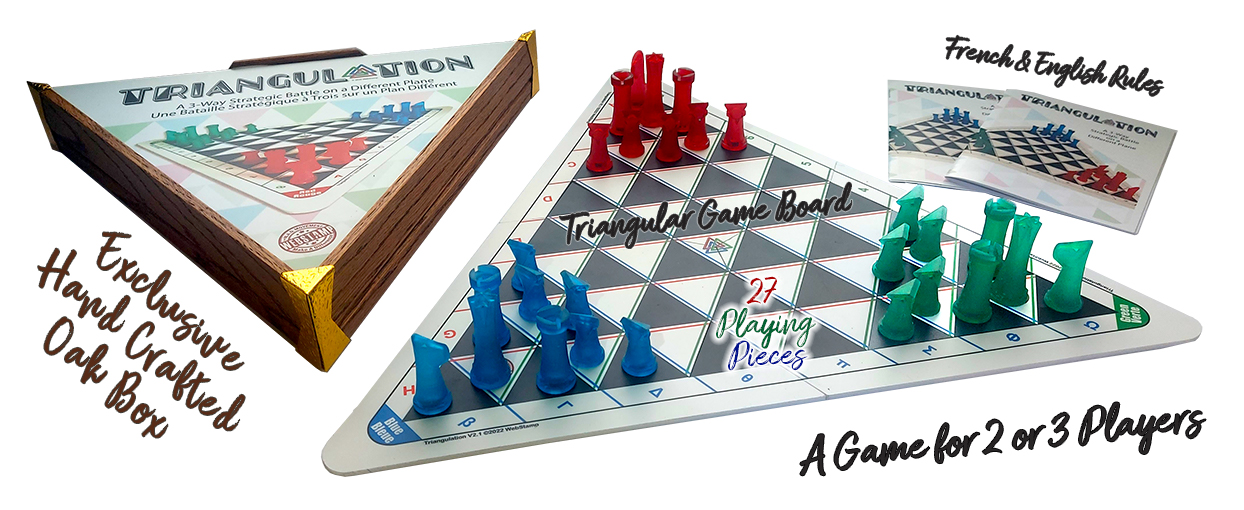
Triangulation is an extra challenging 3-Army Chess Variant for 2 or 3 players. In this strategic battle, a player melees to capture the opponent’s General(s) while avoiding capture. The Game is played on 64 black-and-white triangles on a triangular board. Triangulation employs the ancient Indian strategy game Chaturanga designations, which utilizes army divisions labelled as Infantry, Cavalry, Chariotry (also known as a Rukh in
Persian chess), General, Elephantry, and King. These playing pieces respectively became the Pawn, Knight, Rook, Queen, Bishop, and King in the Middle Ages for the popular game of Chess as we know it today.
Triangulation is played on triangles instead of squares to simplify the direction of each player’s movement. There are 27 playing pieces, divided into 3 sets, 1 set for each army. Each set contains 9 playing pieces: 1 General, 1 Cavalry, 2 Rukhs, and 5 Infantry. Each of the 4 different pieces of each player moves in distinctive ways, somewhat similar to the corresponding pieces in chess. Each army is represented by the different colours Red, Green, and Blue.
A round of play consists of the Red player making the first move, followed by the Green player, with the Blue player making the third and final move. This sequence of moves continues until only 1 General remains or a Draw is called. When one player captures one of the other player’s Generals, the remaining captured army becomes allies for the capturing player.
Initial Setup
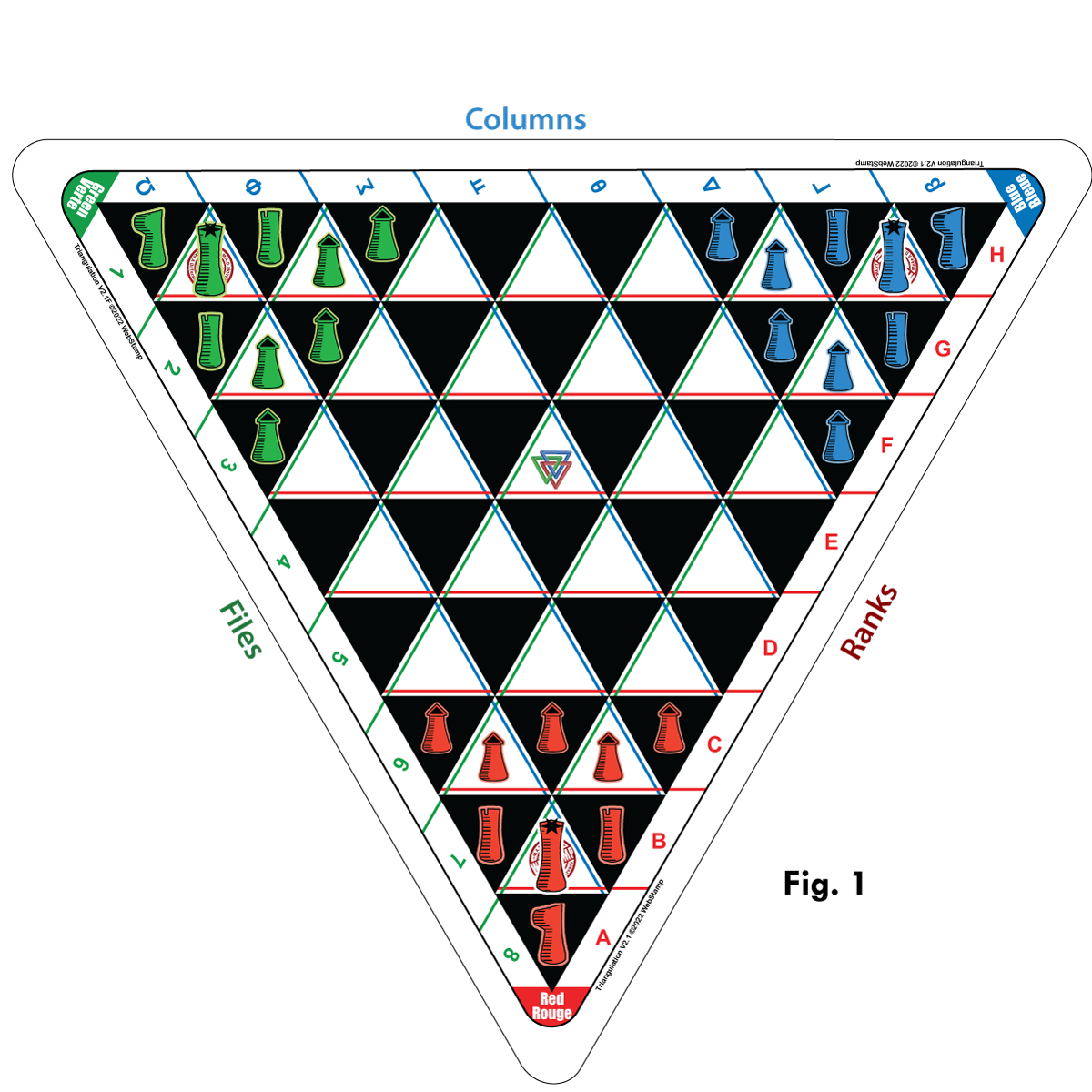
Each player chooses a corner on the triangular board to start from (Red, Green, or Blue) and places their chosen coloured pieces as laid out on the board, as in Fig.1. Placement
- The Cavalry is placed in the similar coloured corner.
- The General is placed in front of.the Cavalry.
- The 2 Rukhs are placed on either side of the General.
- 5 Infantry are placed across the 3rd row;
- ► Red Infantry placed on Rank C,
- ► Green Infantry placed on File 3,
- ► Blue Infantry placed on Column Δ.
Each player is represented by a different colour (Red, Green, or Blue) indicated by the coloured line on the bottom side of the white triangles relative to each player’s corner. Each white triangle has a coloured bar at the bottom of it in the player’s respective colours, with the opposite corner of the triangle indicating the forward motion of play for that particular player. Each round of play consists of the Red Player making the first move, followed by the Green Player, and the Blue Player making the last move in a round. In Triangulation, moves are allowed by travelling across either a side (or sides) or a corner of a triangle (or alternating between both as with the Cavalry) to another triangle. All pieces, except for the Cavalry, cannot move any further than an occupied triangle in their path. A move onto an occupied triangle can only be done by capturing the opponent’s piece located there.
INFANTRY
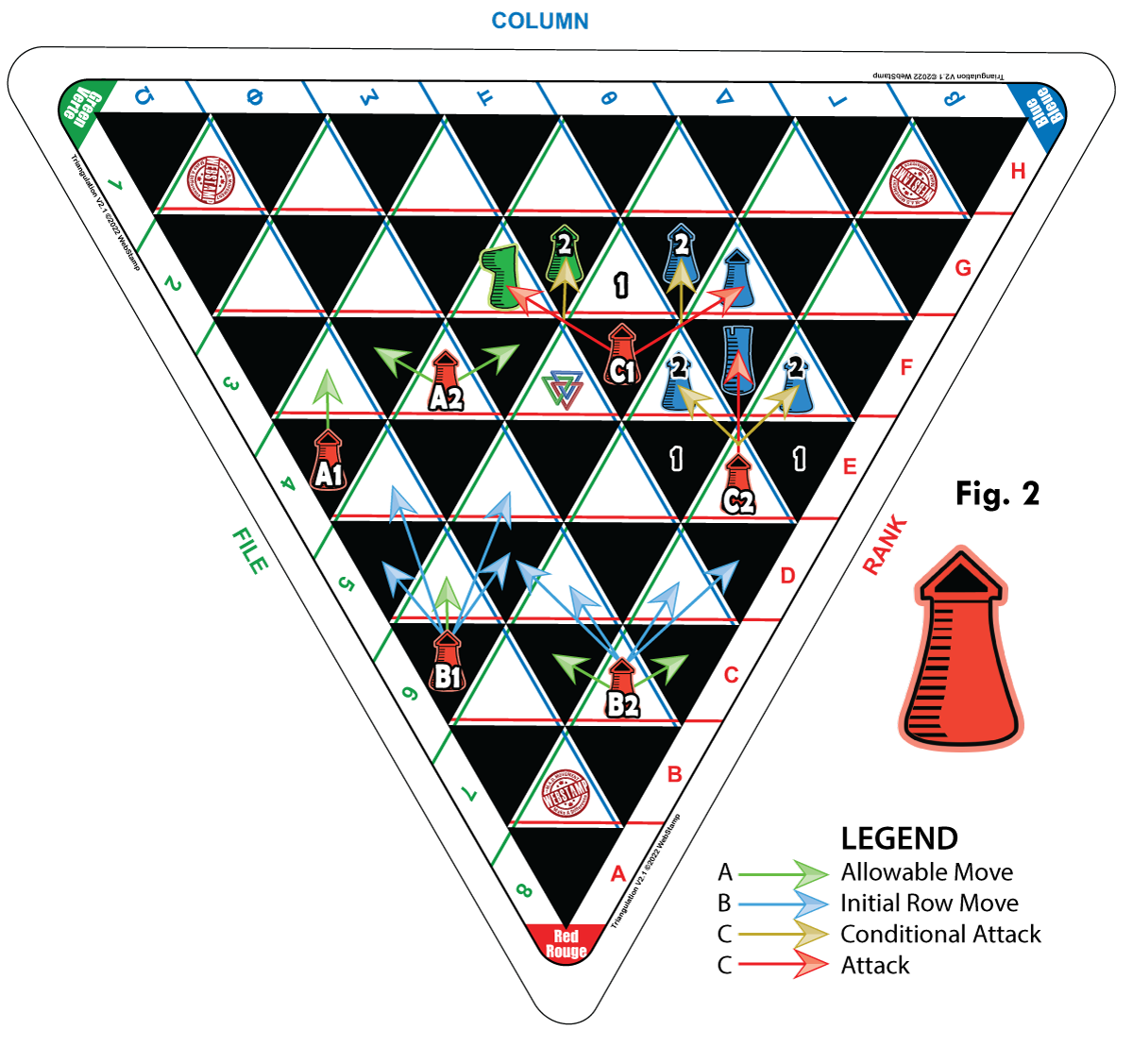
The Infantry is only allowed to move forward over one side of a triangle to an adjacent triangle. When on a triangle with the side in front of the Infantry (A1), it may only move forward 1 triangle. On a triangle with a corner in front of the Infantry (A2), it may move over either side of the triangle, on the left or right side of the triangle, to an adjacent triangle. The Infantry cannot move onto an occupied triangle unless attacking. An Infantry is allowed to charge into battle up to 3 triangles from its starting row (B1& B2).
INFANTRY ATTACKS:
The Infantry can attack from any corner as long as it is in a forward direction
from the attacker’s perspective. On a triangle where the side is in front of an Infantry (C1), it may attack over either corner to the 2 left or 2 right triangles across the attacker’s coloured line. If there is a playing piece on the white #1 triangle, then the Infantry C1 cannot attack either of the black #2 triangles, for those triangles are blocked by that piece on the white triangle #1.
On a triangle with the corner in front of the Infantry (C2), it may attack all 3 triangles over the corner across the Attacker’s coloured line. If there is a playing piece on either of the black #1 triangles, Infantry C2 can’t attack either of the white #2 triangles, for those triangles are blocked by those pieces on the black #1 triangles, respectively. Once an Infantry reaches the opposite side, it is allowed to move sideways along the outer edge, or attack across a corner along the outer edge from a black triangle to another black triangle, to an adjacent triangle in either direction.
Rukh
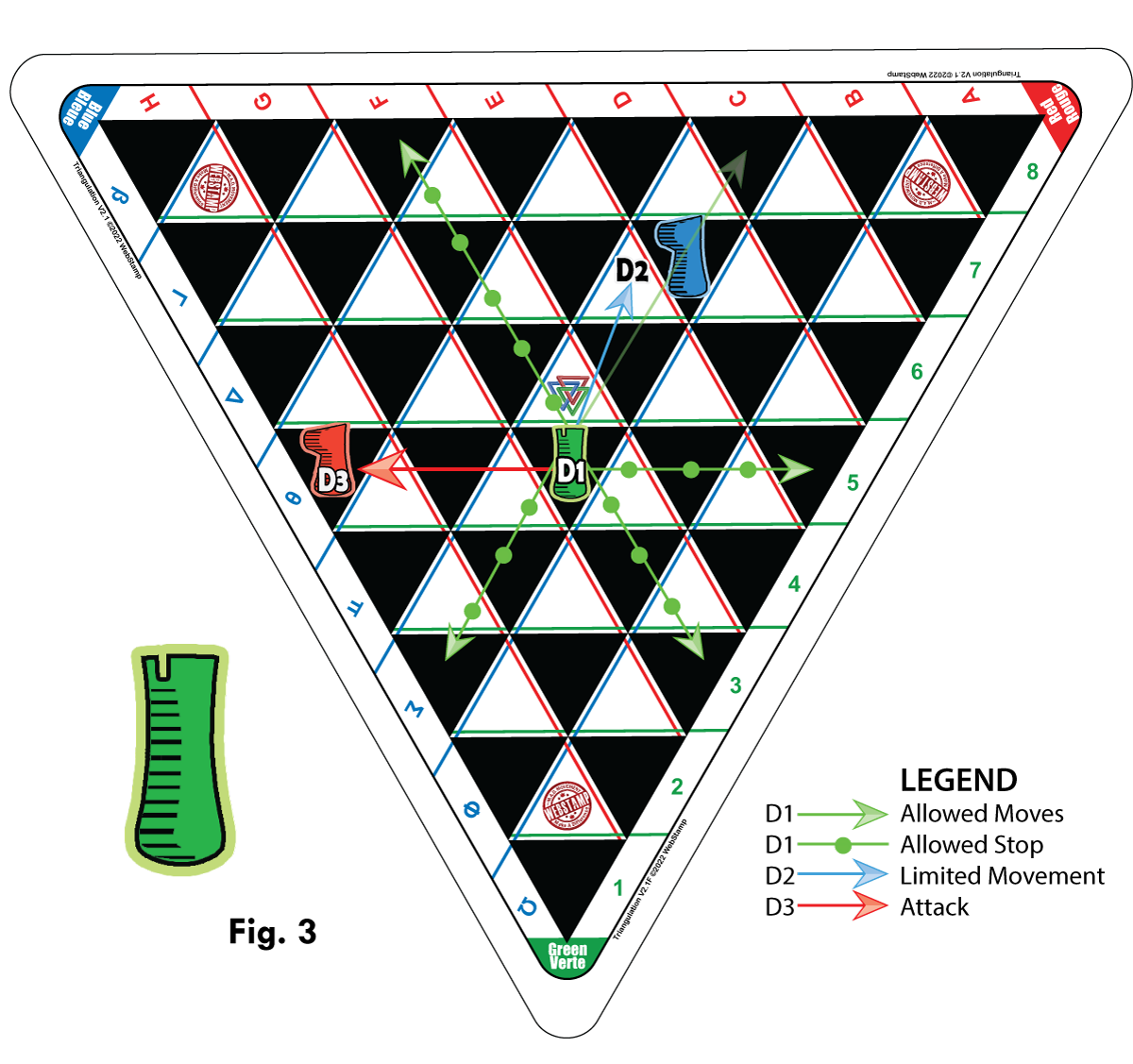
The Rukh can move over any number of sides in a straight path (D1) and can stop on any triangle along this path. The Rukh is not allowed to move any further than the triangle in front of an occupied (D2) triangle by another playing piece, or land on an occupied triangle (D3) and capture the playing piece of an opponent that is in the path of the current move.
Cavalry
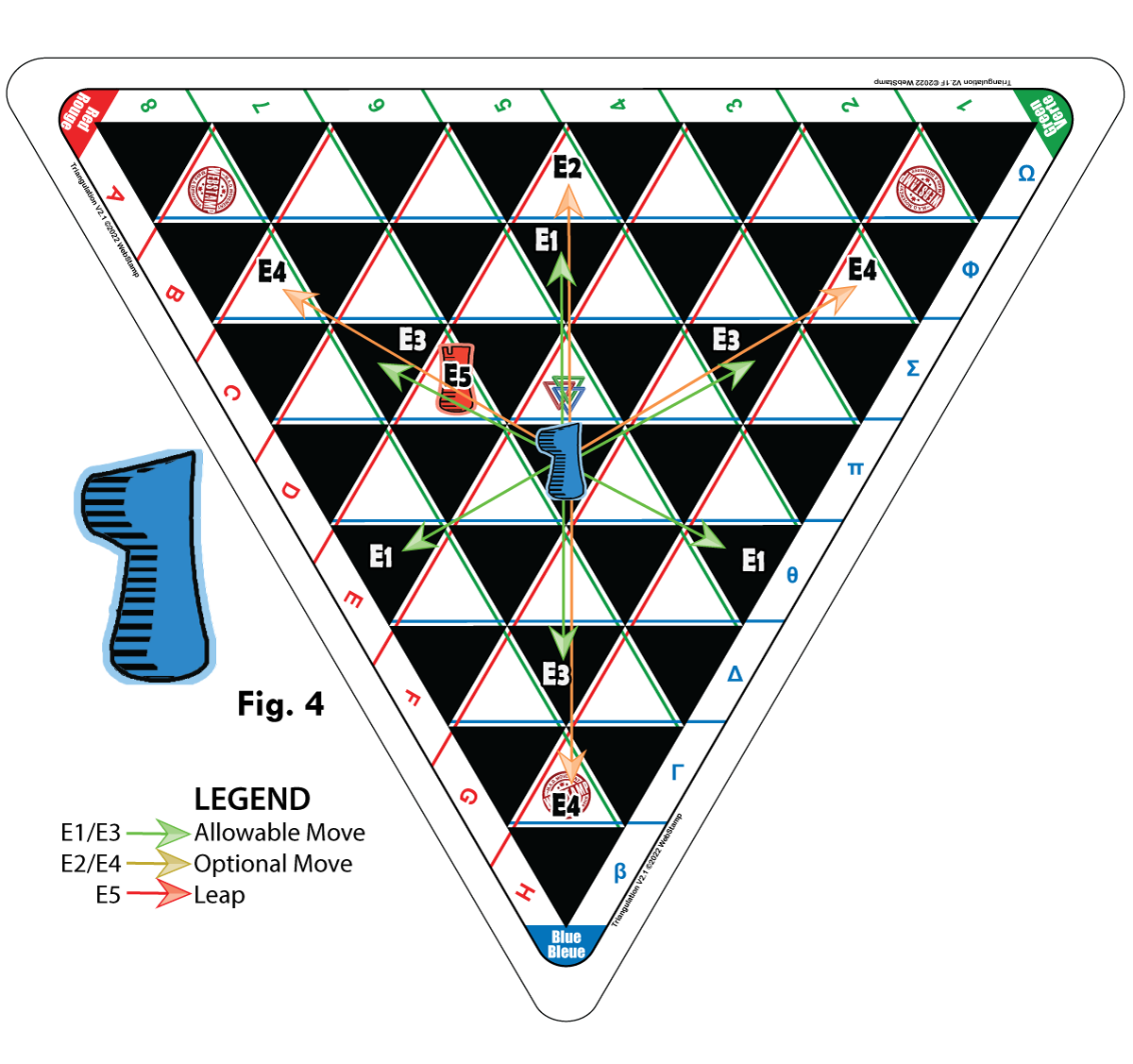
The Cavalry can move either 2 or 3 triangles, travelling over alternating sides and corners in one direction as follows:
1. Start by moving over any of the 3 triangle’s sides, then over the opposite
corner (E1), xor over the optional opposite side (E2).
or
2. Start by moving over any corner, then move over the opposite side (E3), xor the optional opposite corner (E4).
Other pieces do not obstruct the movement of the cavalry, for it is the only piece that can leap (E5) over any playing piece.
General
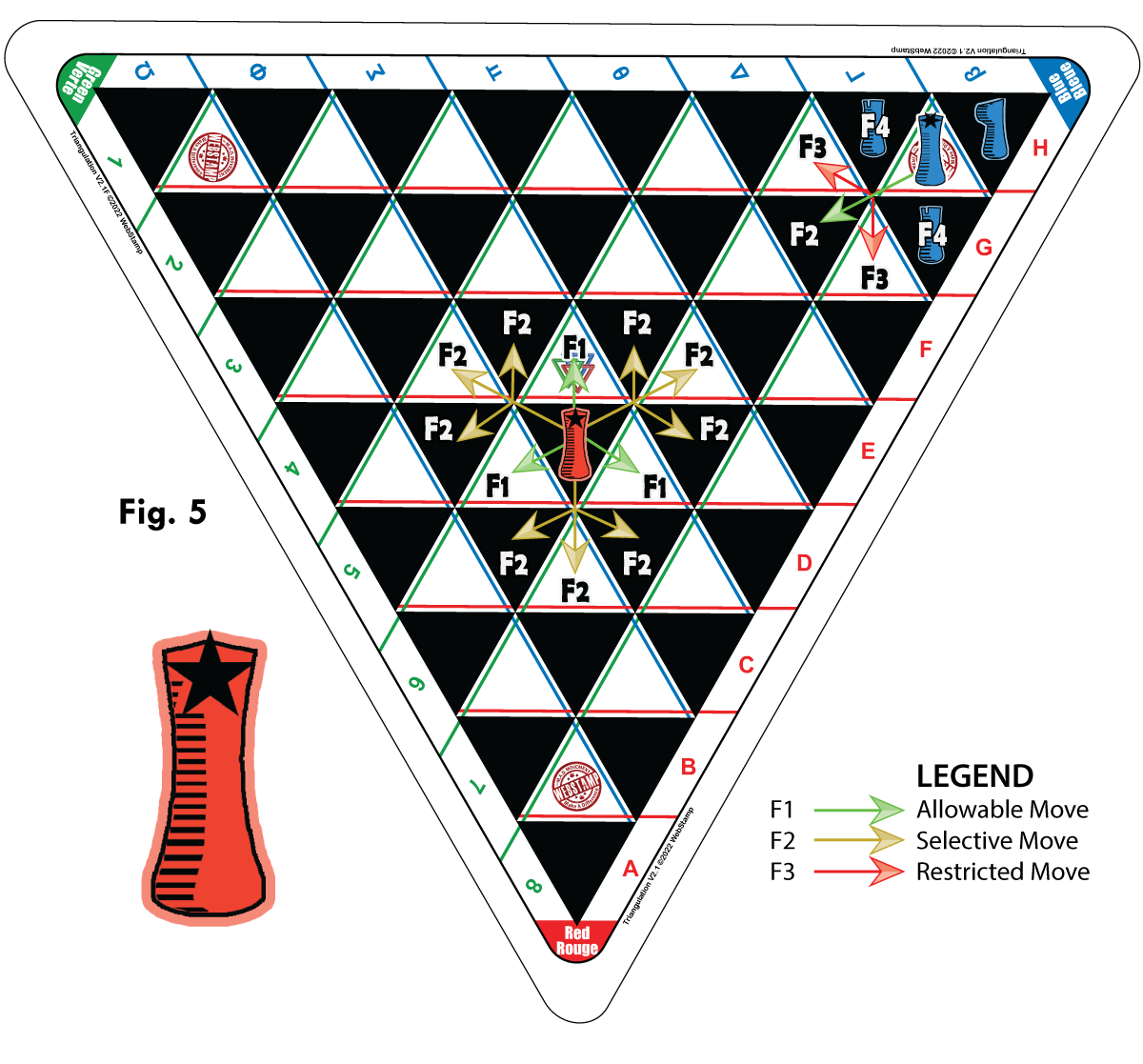
The General can move 1 adjacent triangle in any direction over any side (F1) or to any of the 3 adjacent triangles over a corner (F2). The General may not move over to an F3 triangle if there is a playing piece on an F4 triangle, for that F3 triangle is blocked by the piece on F4. The General may
never move into a position that allows them to be captured (called Check) and must always move out of Check, if possible. If a General cannot move out of Check, then that player is Checkmated. A Check is called by saying: Attacker’s Colour Checks Attacked Colour“ (eg, Red Checks Blue). The
Checkmated player remains in the game and continues to make moves, even allowing moving their own General into a new Check (if there are no other possible moves), until the General is actually captured. When an attacking player checkmates another player, they must capture the General in their next turn, if possible, to actually complete the Checkmate. When a player cannot make a move that puts that player into Check, they must make a move until they are actually captured.
If a Checked attacker has another player in Checkmate, that attacker must execute the capture of the Checkmated opponent’s General before all other moves. A “Double Check” occurs when one player checks both of the other players at the same time. All remaining pieces of a defeated General become the assets of the capturing player. Converted Pawns must move forward or attack in relation to their original colour.
Additional Rules
Rescuing Captured Playing Pieces, where an Infantry may rescue a captured piece by moving to the black corner triangle of the other player that has the captured piece. Only pieces that have been captured by that other player can be rescued, and the recovered piece is placed in the opponent’s corner triangle to resume play. The Infantry that did the rescue is returned to any of the open triangles in the 3rd row in their corner (Rank C-Red, File 3-Green, Column Δ-Blue) to continue play. If the only possible result is being able to rescue an Infantry, then both Infantries retreat to any open 3rd-row triangle of their corner to continue play. A player cannot rescue a non-existing piece captured by that opponent. An Allied (captured) Infantry may rescue one of its captured pieces of either colour from its new colour-designated corner.
Castling
A General may exchange places with either Rukh as a move. Castling is only possible if neither the General nor the Rukh that is exchanging places has moved, and the General is not in, or moving into check.
Ending the Game
The game of Triangulation ends when only 1 General (player) remains. If any of the remaining players have difficulty resolving to conquer the other players, the game can be called a Draw. If only 2 players remain in the game, then it is a draw between those players, for the other player has already lost the game. A Draw is called immediately when either 2 or all 3 remaining players have only a General remaining, for a General cannot move into Check to check another General.
2 Player Gameplay
In a 2-Player game, the 3rd army is neutral and out of play until either player captures the 3rd General. Once captured, the remaining playing pieces of the neutral army become allies for the capturing player. Allies must follow the rules associated with their colour. The setup of the playing pieces is as in regular play, except with the General of the 3rd (neutral) army exchanging places with the Cavalry being placed in the corner triangle. The game ends, as in a 3-player game, when only 1 General remains.
Labelling and Designations
Each triangle on a Triangulation board has a specific designation for easy reference to where a playing piece moves from one point to the next, and to provide an easy way to keep records of the moves made. Each of the 3 sides on the board is labelled with a unique, different notation scale for easy distinction. The Red rows (Ranks) are denoted with capital letters A through
H, the Green rows (Files) with numbers 1 to 8 and the Blue rows (Columns) are depicted with Greek letters1 β through Ω. The 3 scales are read in the order of a Capital Letter, Number, and Greek Character (eg: F6Σ). Each triangle on a Triangulation board is identified as in Figure 6.
1 In alphabetic order with the Greek letters that are similar to capital letters omitted to prevent confusion between the different scales.