
The History of Triangulation
Ever wanted to play chess with 3 people present? Well, back in the early 70s, that was a constant dilemma my friends and I faced regularly. It was at that time that I decided to design my own version of chess playable with 3 people. I began designing the board using triangles to accommodate all the playing pieces for each army. It became apparent quickly that the bishops and the knights might have issues conversing in triangles. The Bishops travelled around in circles, and it was hard to maneuver the knight in an L-shaped pattern. So I put that project on hold to solve those and other issues at a later date and created a 3-player chess called Thress that is played on hexagons.
Fast forward to 2020, I was looking through my idea book and came across my first attempt at 3-army chess and decided to try again using triangles. I realized I had to remove several pieces, like the bishops, to make this version of chess work. So I removed the Queen and the Bishops due to their illogical moves. To accommodate the pieces to fit on the board, I also removed 3 Pawns and a Knight. It was later decided to rename the playing pieces after the original chess Chaturanga, which originated in India around the seventh century AD, to distinguish the game as an alternate version of chess. The pawns became Infantry, the rooks reverted to Chariots (called a Rukh in Persian chess), the knight was restored to cavalry, and the king was updated to the General.
Now it was time to calculate how the pieces move over triangles. The Ruhks were easy; moving over the sides of a triangle in a straight line in 3 directions. The General has 3 triangle sides it can move over and 3 corners that are attached to 3 triangles for a choice of 12 moves. With the Calvary, since we couldn’t move in an L-shape, we had to come up with a unique move in relation to the other pieces. Instead of moving over just a corner or side, the rule of moving over alternating sides and corner (or corners and side), moving two or three triangles was implemented for the Calvary.
Figuring out the Infantry moves was a little more difficult. The Infantry has either one forward move (triangle side) or four triangles it can attack, or a choice of two forward moves (left or right side) and 3 triangles of attack. After extensive testing, the rule allowing a pawn to move 2 squares on its first move was modified for the Infantry to move 3 triangles on its first move. This rule was changed to improve reaching the centre of the board more quickly.
I then built bi-fold game boards, 3D printed the playing pieces, and built rhomboid-shaped oak boxes. The boards evolved into a 3-piece interlocking board. I then attended several chess clubs and introduced the game Triangulation with enthusiastic results. Most found the game a refreshing, new and exciting take on chess, even the chess masters.

The M.A.D. Movement
Your M.A.D. Move can be anything from giving someone a helping hand, volunteering for a good cause, or donating, even a little, to a charity or organization.
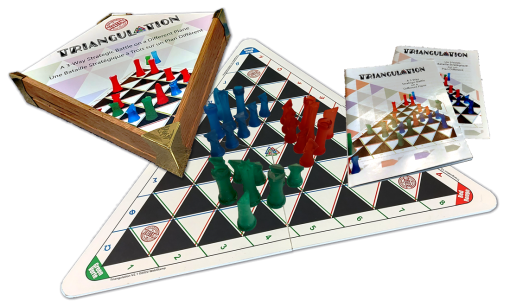
Triangulation
Discover and understand a new version of chess designed for the 21st Century. Triangulation is an extra-challenging 3-Army Chess variant with more than One Angle.